"Warm Transfer vs Blind Transfer: Handing AI Calls to Human Agents"
How an AI voice agent should hand a qualified lead to a human — warm versus blind transfer, passing conversation context, and doing it cleanly over AMI or ESL.
By Tayoga Wasneski
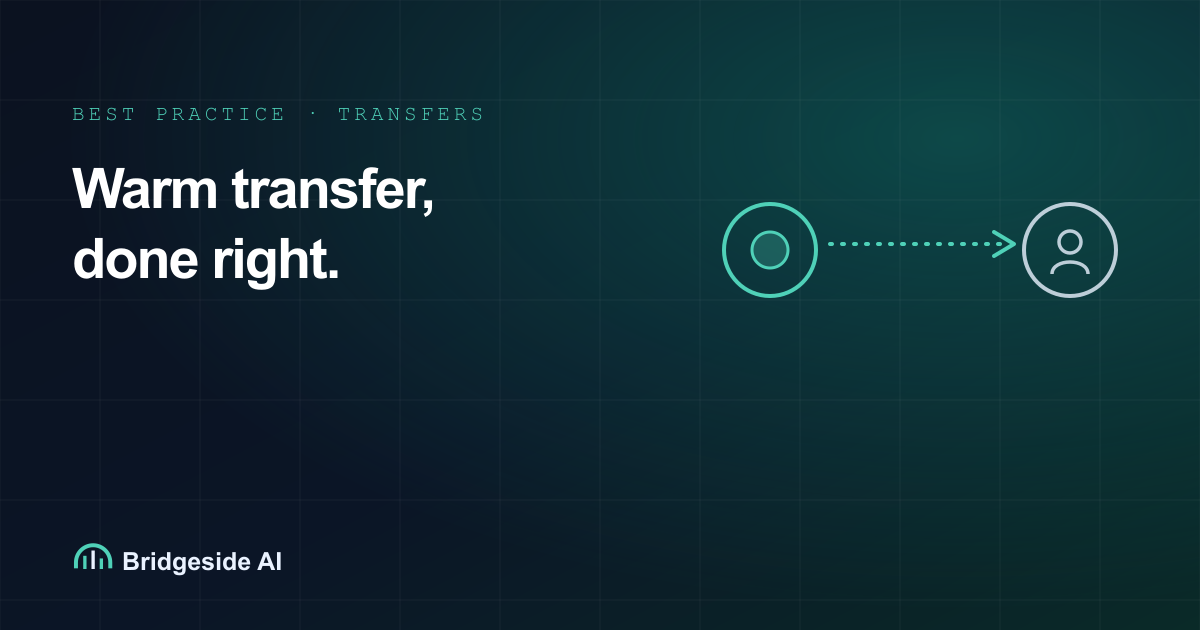
The moment an AI voice agent earns its keep is the handoff. The agent has answered, followed the script, qualified the lead, and now there is a hot prospect on the line who should talk to a human closer. How that handoff happens — warm or blind, with context or without — often matters more to your conversion rate than anything the AI said earlier. Get it right and your closers pick up pre-qualified, briefed conversations. Get it wrong and you squander good leads at the finish line.
This article covers the difference between warm and blind transfers, when to use each, and how to pass conversation context so the human starts warm rather than cold.
The two kinds of transfer
Blind transfer (also called cold transfer) moves the call to another destination and drops the originating party out. The human who receives it gets a live call with no briefing. They hear the lead, but they do not know what was said before, who the lead is, or why the call was escalated. They start from zero.
Warm transfer connects the human to the context of the conversation, not just the call. In its fullest form, the human joins a call that is already live with the lead, and they arrive knowing who the lead is and what the AI learned. The lead does not have to repeat themselves, and the closer does not have to start with "so, what can I help you with?"
For AI-driven outbound, warm transfer is almost always the better choice, because the entire value of the AI first touch is the qualification and context it produces. Throwing that away with a blind transfer wastes the work.
What "warm" really requires
A truly warm transfer needs three things to arrive together:
- The live call — the lead stays connected through the handoff and never gets hung up on or re-dialed.
- The lead's identity — name, number, campaign, and any CRM record, on the closer's screen.
- The conversation context — a short summary of what the AI established: the need, the objections raised, the qualification answers, and the reason for escalation.
Miss any of these and the transfer degrades. Live call without context is just a blind transfer with extra steps. Context without the live call is a callback, which loses the momentum of a lead who is ready right now.
How the transfer happens technically
The mechanics depend on your telephony platform, but the pattern is consistent: the AI agent decides to escalate and issues a control command to bridge the live channel to a human destination.
- On Asterisk and VICIdial, this happens over the Asterisk Manager Interface (AMI). The agent issues a redirect or originate to move the lead's live channel to a specific agent extension, an in-group, or a closer queue. Because the lead's channel is already up, the human joins a call in progress.
- On FreeSWITCH, the same thing happens over the Event Socket Layer (ESL). The parked, live call is bridged or transferred to a human destination with an ESL command.
In both cases the lead never leaves the call. The human is added to a conversation that is already happening, which is the essence of a warm transfer.
Passing context to the human
The technical bridge gets the human onto the call. The context is what makes them effective. There are two complementary ways to deliver it:
On-screen briefing. The closer's CRM or agent screen pops with the lead record and a short AI-generated summary: "Homeowner, roof is 18 years old, interested in a quote, asked about financing, wants a morning appointment." A closer who reads that in two seconds opens with exactly the right sentence.
Whisper or announcement. Some setups play a brief private summary to the human before they are connected to the lead, or the AI stays on for a beat to introduce the closer. This is optional, but a spoken one-line handoff ("I've got Maria on the line, she's interested in a quote and asked about financing") can make the transition feel seamless to the lead.
The best deployments use the on-screen briefing as the default and reserve the spoken handoff for higher-value calls where the extra polish pays for itself.
When a blind transfer is actually fine
Warm is usually right, but not always. A blind transfer is acceptable when:
- The destination is a self-contained queue where any agent can handle any call and context is minimal (for example, "connect me to billing").
- The volume is high and the value per call is low, so the overhead of context passing is not worth it.
- You are transferring to an IVR or system, not a person who needs briefing.
If the receiving human needs to know anything about the specific lead to be effective, use a warm transfer.
Deciding when to transfer at all
A good AI agent does not transfer every call. Over-transferring buries your closers in unqualified conversations and destroys the efficiency you bought the AI for. Set clear thresholds:
- Qualified and ready — transfer warm to a closer.
- Interested but not ready — book a callback or an appointment, do not transfer.
- Not qualified or not interested — disposition and end the call politely.
- Explicit request for a human — transfer, always. If a lead asks for a person, give them one.
Tuning these thresholds is where a pilot pays off. Listen to a day of calls, look at which transfers your closers found valuable, and adjust. The goal is that every warm transfer feels, to the closer, like a gift: a briefed, ready, qualified lead.
Handling a failed transfer gracefully
Sometimes no human is available — everyone is busy, or it is after hours. The agent needs a graceful fallback rather than dead air:
- Offer to book a specific callback time and capture it.
- Take a message and a good number, and confirm it.
- Set a disposition that flags the missed opportunity so a human follows up fast.
Never let a hot lead hit silence because the transfer target was unavailable. The fallback is part of the design, not an edge case.
The payoff
Warm transfers are where AI first-touch and human closing combine into something better than either alone. The AI does the patient, consistent, tireless work of qualifying every lead and capturing context. The human does the thing humans are still best at: building rapport and closing a ready buyer. The transfer is the seam between them, and when it carries the live call plus the context, that seam disappears.
If you want to see a warm transfer with full context passing on your own dialer, get in touch and we will demonstrate it on a live call.