Adding AI Voice to Your Call Center Without Ripping Out Your Phone System
Why the "switch to our platform" approach to AI is the wrong trade for an established call center, and how an overlay integration lets you add AI while keeping your dialer, numbers and workflows.
By Jorge Goytisolo
Every call center evaluating AI voice runs into the same fork in the road. One path says: move your operation onto our all-in-one AI platform. The other says: keep the dialer and phone system you already run, and add AI as an overlay. For an established operation, that choice matters more than which AI sounds the most natural in a demo. This article makes the case for the overlay approach, explains how it works, and gives you the questions to ask any vendor so you do not accidentally sign up for a migration you did not want.
The hidden cost of "switch to our platform"
The all-in-one pitch is seductive because it is simple: one vendor, one dashboard, everything included. But for a call center that already runs VICIdial, Asterisk or FreeSWITCH, "switch to us" means giving up a lot that does not show up in the sales conversation:
- Your list management and pacing logic, tuned over months or years.
- Your reporting and the metrics your team lives by, which will be different on a new platform.
- Your integrations — CRM, dispositions, quality tooling, wallboards.
- Your phone numbers and carrier relationships, and the deliverability you have built.
- Your team's muscle memory. Retraining a floor on a new platform is a real, ongoing cost.
And that is before the migration itself: remapping campaigns, moving lists, revalidating compliance suppression, and the inevitable period where two systems run in parallel and nothing is quite right. The AI might be excellent, but you paid for it with a platform migration you did not need.
The overlay approach: add AI, keep everything else
The alternative treats AI as a capability you add to your existing stack, not a platform you move to. Your dialer keeps doing what it does — placing and pacing calls, managing lists, recording, reporting — and the AI voice agent connects to it as a destination. The whole integration surface is small and reversible.
Concretely, on VICIdial, Asterisk or FreeSWITCH, that means:
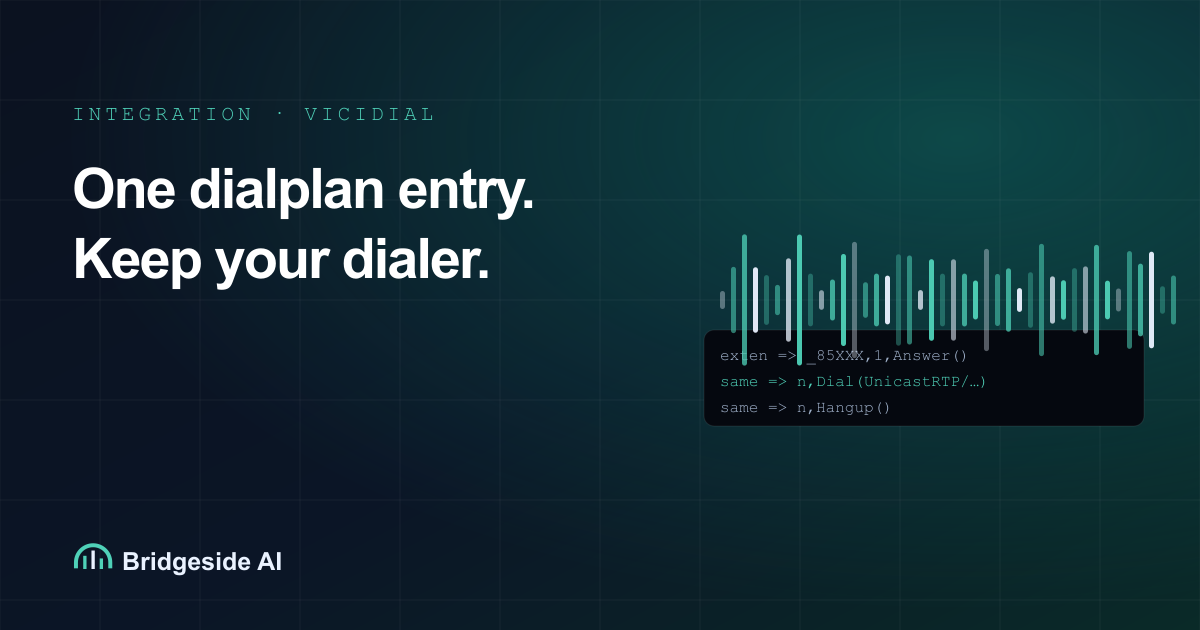
- One dialplan entry routes calls to the AI. Audio streams to the agent and back in the codec you already use.
- AMI or ESL handles transfers and hangups, so the agent can warm-transfer a hot lead to a human or end a call, using interfaces your system already exposes.
- Dispositions are written back to your dialer or CRM, so your reports and your DNC logic stay intact.
That is the entire footprint. No new dashboard your team has to learn to place calls, no migration of lists, no change to your numbers.
Why "one dialplan entry" is more than a slogan
The reason the overlay approach is so low-risk comes down to how little it touches. A single dialplan entry means:
- You can pilot in an afternoon. Point one campaign at the agent, listen to a day of calls, and decide.
- You can turn it off instantly. Remove one route and you are back to exactly where you started. There is no lock-in because there was no rip-and-replace.
- You keep experimenting on the platform, not the dialer. New scripts, new voices, A/B tests — all happen on the AI side. The dialplan never changes again after the first entry.
Compare that to a full migration, where "let us try it" is a quarter-long project and "let us turn it off" is another one. The overlay approach keeps AI in the category of things you can just try.
What you keep, explicitly
It is worth being concrete about what stays yours in the overlay model:
- Your dialer, with its pacing, skins and list logic.
- Your phone numbers and carrier setup, with their reputation and deliverability.
- Your recordings, captured by your existing system, since the AI is just the far end of a normal bridge.
- Your reporting, because dispositions land in the same schema as human calls.
- Your compliance suppression, because opt-outs and DNC flow back into the list system you already trust.
You are adding one thing — a very capable voice on qualified calls — and keeping the rest of a system you already know works.
The questions to ask any AI vendor
Whether or not you talk to us, these questions separate an overlay from a migration. Ask them early:
- Does this run on my existing dialer, or do I move to yours? If the answer is "you move to ours," you are evaluating a platform migration, not an AI add-on.
- What exactly changes on my Asterisk/VICIdial/FreeSWITCH? A good answer is small and specific: a dialplan entry, scoped AMI/ESL access. A vague or large answer is a red flag.
- How do transfers to my human agents work? You want warm transfer over AMI or ESL with context, keeping the lead on the live call.
- Where do recordings live? Ideally, wherever they live now. You should not need a parallel recording system.
- How do dispositions and DNC flow back? Opt-outs must hit your suppression in real time, and outcomes must land in your reports.
- How do I turn it off? If the answer is not "remove one route," you have lock-in.
- What do my numbers and carrier relationships do? In an overlay, they do not change.
If a vendor's answers to these keep pointing back to their platform, you are being sold a migration dressed as an AI feature.
When a full platform actually makes sense
To be fair, the all-in-one approach is not always wrong. If you are starting from scratch with no existing dialer, or your current system is genuinely at end of life and you were going to replace it anyway, a combined platform can be a reasonable choice. The overlay argument is specifically for operations that already have a dialer that works. If that is you, the question is not "which platform should I move to," it is "how do I add AI to what I already run."
The bottom line
An established call center's dialer is not a liability to be replaced; it is an asset that already does the hard parts well. The right way to add AI is to keep that asset and overlay the one capability it lacks — a tireless, consistent voice on your qualified calls — through one dialplan entry and the control interfaces your system already exposes. You keep your numbers, your reporting, your recordings and your team's expertise, and you can try it, scale it, or switch it off on your own terms.
If you want to add AI to your call center without touching your phone system, get in touch and we will pilot it on a single dial code so you can hear it on your own calls first.